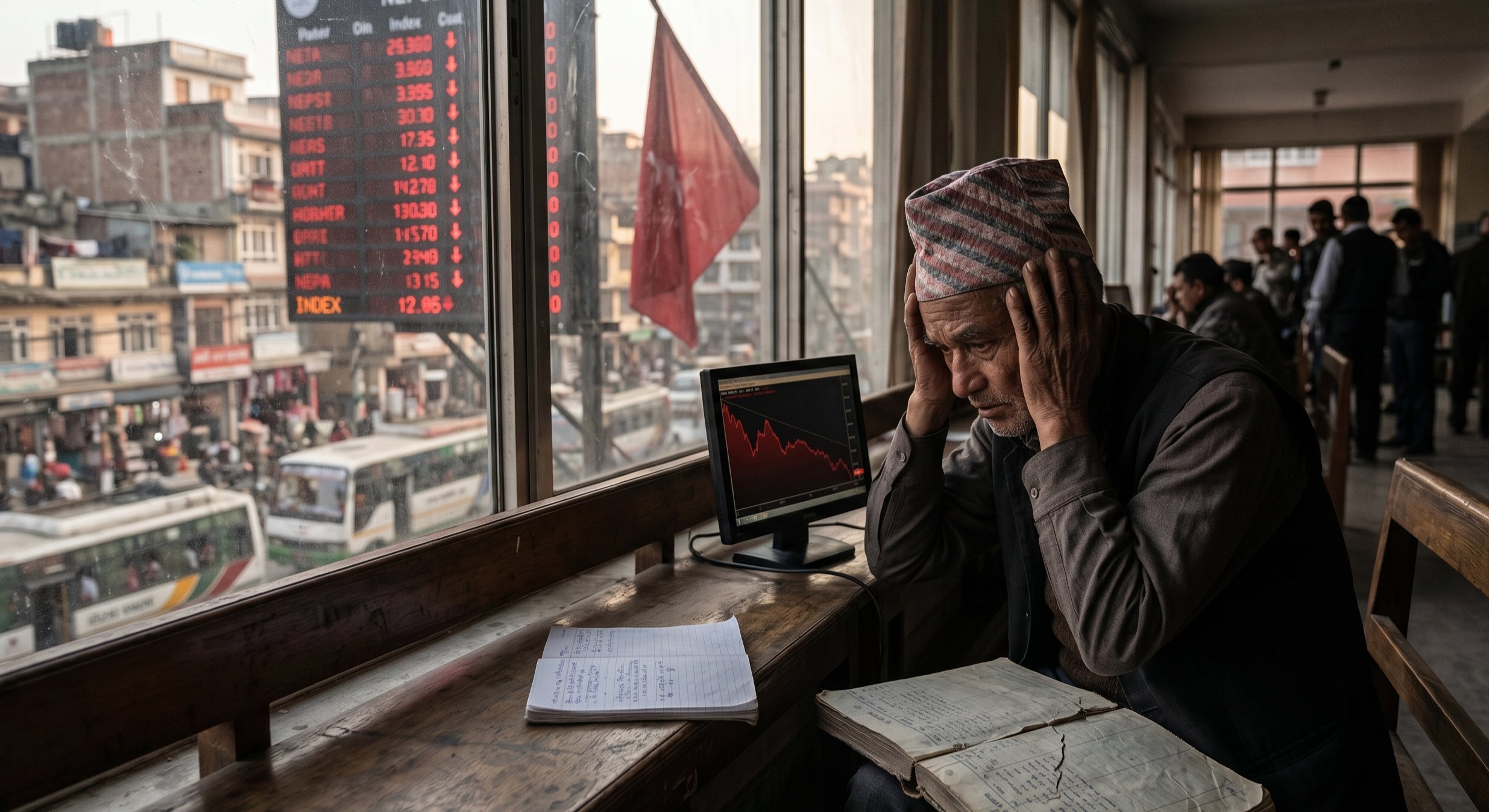
The stock index fell 16.38 points on Friday while regulators pushed to clean up Nepal’s reputation with international financial watchdogs.
The Nepal Stock Exchange closed out the trading week on a downbeat note, with the NEPSE index shedding 16.38 points to end the day lower. Daily turnover came in at Rs 4.48 billion, a marginal improvement that offered little comfort to investors watching their portfolios drift. Microfinance stocks and a handful of hydropower listings managed small gains, but the broader market remained under pressure.
The dip reflects a market that is struggling to find positive catalysts. Banking sector profitability is being squeezed by the excess liquidity problem. Private sector investment is sluggish. And the upcoming budget, while anticipated, brings uncertainty about which sectors will benefit and which may face new taxes or regulatory changes. In that environment, many investors are choosing to wait rather than build positions.
Beneath the daily index movement, a more significant challenge is unfolding in Nepal’s financial governance. The country remains on the Financial Action Task Force grey list, an international designation that signals inadequate controls against money laundering and terrorist financing. Being grey-listed is not just a reputational issue. It affects the terms on which Nepali banks can do business internationally, adds friction to cross-border transactions, and can increase the cost of trade finance.
Regulators have identified several specific gaps that need closing: tracking of digital finance transactions, oversight of informal remittance channels known as hundi, and monitoring of underground capital movement. These are not simple fixes. They require legislative changes, better technology, and significant capacity building in oversight agencies.
In a separate but related development, Nepal’s Anti-Money Laundering Agency recommended this week that 29 individuals be formally prosecuted in connection with a multi-billion rupee financial fraud case. The recommendation signals that agencies are moving toward more aggressive enforcement which is a necessary step if Nepal wants to demonstrate to international bodies that its financial system is tightening up.
Whether the combination of new laws, enforcement actions, and regulatory upgrades will be enough to get Nepal off the grey list in the near term remains to be seen. The process is slow and the criteria demanding. But each prosecution, each tightened regulation, and each technology upgrade moves the needle in the right direction.