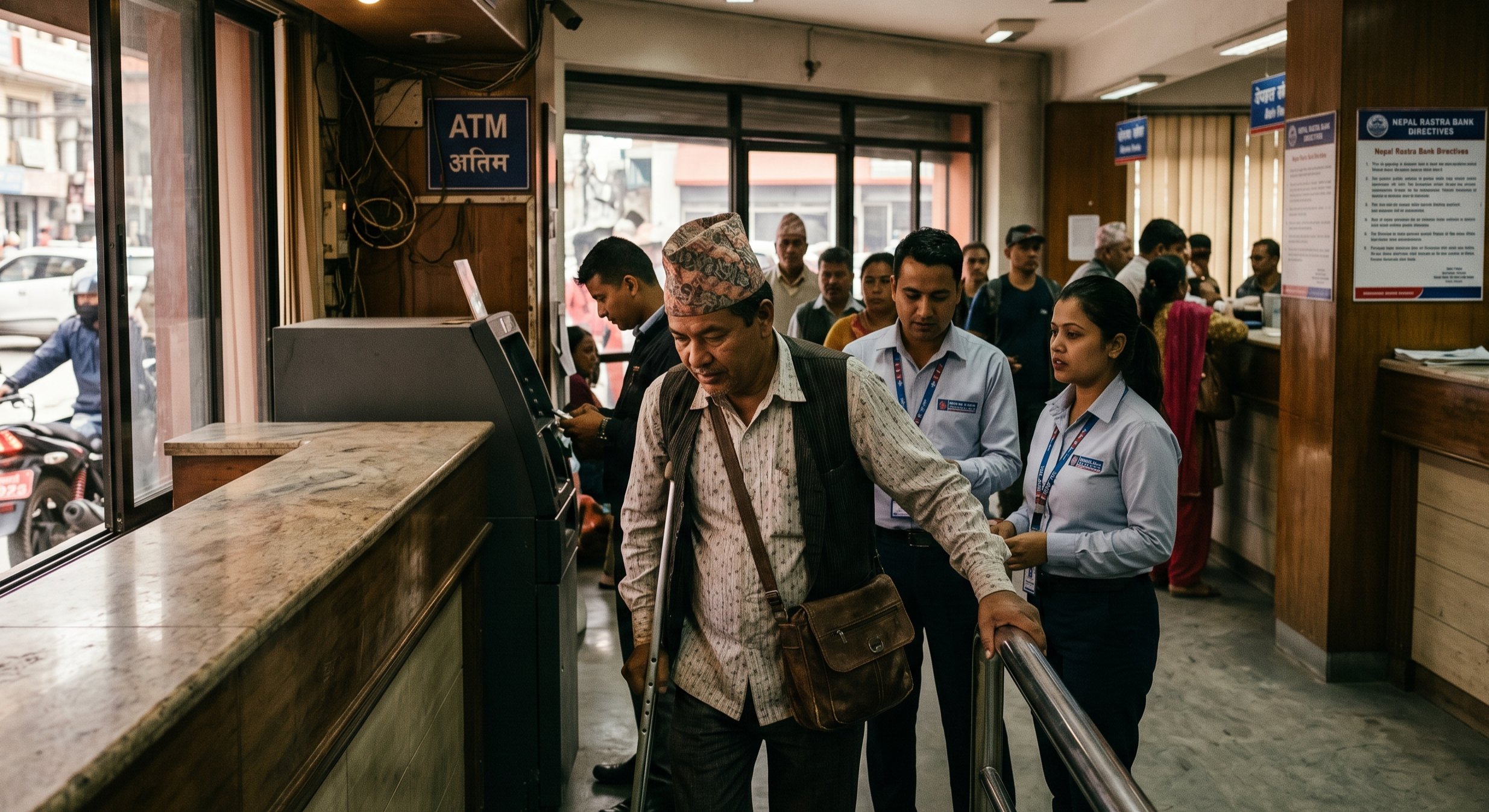
KATHMANDU — Nepal Rastra Bank has introduced a sweeping set of structural updates to its unified directives. The country’s central bank has legally mandated all commercial banks and financial institutions to transition into fully inclusive, disability friendly financial ecosystems.
The announcement, released on Sunday, May 24, 2026, forces a major operational pivot for the domestic banking sector. Lenders must now systematically redesign their physical infrastructure, customer service protocols, and digital applications. The directive aims to ensure that senior citizens, persons with disabilities, and illiterate individuals can access the financial grid without facing physical or systemic discrimination.
Shared Local Coverage and Tactile Hardware
One of the most notable features of the central bank’s updated circular is a collective operational model. Instead of forcing every individual brand to build separate, costly setups everywhere, Nepal Rastra Bank has ordered commercial banks to coordinate directly with one another. This partnership must guarantee that at least one disability friendly branch operates within every single local government level across Nepal.
Alongside physical branch network commitments, hardware standards at automated teller machines are undergoing a major evolution. Moving forward, banks must install at least one accessible ATM equipped with braille sign control buttons and built-in audio support services at all major standalone ATM lounges. To ensure transparency, financial institutions are required to publish the location details of these specialized branches and hardware assets directly on their public corporate websites.
Overhauling Digital Architecture and Tactile Cards
The regulatory upgrade extends deep into digital banking interfaces. The central bank has directed all licensed institutions to redesign their web domains and mobile applications to make them accessible to visually impaired consumers. Furthermore, newly issued debit and credit cards must now feature specific tactile indicators, allowing visually impaired users to physically identify and navigate their plastic payment cards.
In a bid to eliminate bureaucratic gatekeeping, Nepal Rastra Bank clarified that digital banking enrollment can no longer be restricted by subjective bank assessments. If an individual with a disability self-declares an inability to handle applications independently, the bank is legally obligated to provide setup support rather than denying service.
Key Directive Takeaways:
- Local Coordination: Banks must collaborate to ensure one disability friendly branch exists per local tier.
- ATM Hardware Upgrades: ATMs at major lounges must include braille controls and text-to-speech audio outputs.
- Inclusive Design: Visually accessible mobile apps and physical cards with tactile patterns are now mandatory.
Financial Impact and Next Steps
This dual policy update represents an aggressive shift toward corporate social governance. For banking executives, the immediate task involves expanding near-term capital expenditure budgets to cover accessibility hardware, application upgrades, and specialized branch renovations.
Looking forward, this policy creates a far more egalitarian financial infrastructure for thousands of marginalized citizens. Over the coming quarters, the banking sector’s execution speed will dictate whether these measures successfully cultivate true financial inclusion, or simply add regulatory friction to institutional balance sheets.